Category: Public

Shirley Remains in Level 3 Critical Drought

From the Executive Office of Energy and Environmental Affairs:  While much of the state received much-needed rainfall in early July resulting in temporary increases in streamflow, Massachusetts continues to experience the effects of two years of below-average precipitation. During June, the state received between 1.5 and 4.5 inches of rainfall. Precipitation deficits continue to persist in all regions, with the greatest deficits on the Islands and the eastern and far southwest parts of the state. Nantucket continues to experience severe dry conditions. Precipitation is at record low coupled with extremely high evapotranspiration, and groundwater levels have seen significant declines. The rains this week have provided some respite. Looking back over the past 3 months (May 7–July 6), most of the state has received between 50 and 100 percent of normal precipitation. The greatest deficits were observed in the eastern and far southwest part of the Commonwealth, but especially for the Islands, who have seen between 32 to 50% of normal rainfall since May 7th. Over the past 6 months (January 7–July 6), longer-term precipitation deficits continued across the Commonwealth, running about 60 to 90 percent of normal. The largest deficits continued to be confined to areas in western, eastern and northeast Massachusetts and the Islands, where precipitation ranged between 50 to 75 percent of normal. As outlined in the Massachusetts Drought Management Plan, a Level 3 – Critical Drought requires affected communities to implement a ban on nonessential outdoor water use. The drought levels also require ongoing coordination among state and federal agencies to implement drought response actions such as water-use restrictions. Additionally, engagement with municipalities, including local Boards of Health (BOH), is essential. This includes providing technical outreach and assistance to water suppliers and affected municipalities. Residents are asked to report to their local BOH if wells are drying up; BOHs are asked to report on the condition of local private wells. The Massachusetts Department of Environmental Protection (MassDEP) will continue to assist communities in managing their water systems. However, private well users and other sources of water within the same river basins are impacted by drought conditions. All sources of water, regardless of their location or type of withdrawal, ultimately draw from the same river basin. It is important for all users to do their part to conserve water. Please note that even during a drought, to continue operational activities such as flushing and spring maintenance, water suppliers may need to use higher volumes of water.    Residents can report dry environmental conditions and submit photos to help monitor the situation on the Massachusetts Water Impact Reporter. Additionally, a FAQ is now available for questions regarding the current drought status and water conservation; and private well owners can learn more for information on how the drought may impact them.    State agencies will continue to closely monitor and assess conditions across the state, coordinate any needed dissemination of information to the public, and help federal, state, and local agencies prepare additional responses that may be needed in the future. The DMTF will meet again on August 6th at 10:00 AM. For further information on water conservation and what residents can do, visit the EEA’s drought and water conservation pages.

Shirley’s Memorial Caisson

By Sharon Landry The crosses on the Memorial Caisson represent Shirley residents who were killed in action in WWI, WWII, the Korean and Vietnam wars. At first, the crosses were stuck in the ground where the monuments are in Whitely Park by the DAV.  When the WWI monument was moved from the diamond on Harvard & Lancaster Road to Whitely Park they couldn’t go there anymore so the Legion built the platform to mount the crosses.    According to the Cambridge Dictionary,  this kind of caisson is a two-wheeled wagon or chest used to transport artillery ammunition near the battlefield. In modern times, these retired military wagons are most commonly seen in military funerals (such as those at Arlington National Cemetery) to carry a casket, followed by a riderless horse.  Rudy Kurtyka originally donated the Shirley Caisson, which came from the National Guard back in the 50s or 60s.  Originally it was an ammunition carrier, the original doors and tubes are still there but you can’t see them because of the platform.    Joe Landry painted it black and built the dolly under the caisson to be able to move it around for Wilma Brown’s funeral in Harvard.  Crosses were mounted after that.    Joe remembers the caisson being used for Alfred “Beechie” Beach’s funeral and he thinks it was also used for Rudy Kurtyka’s funeral.  Possibly others that he doesn’t remember. About 20+ years ago John Guthrie and Joe put the current platform on with the green rug, which was donated by the McNiff family. Joe instigated the recent refurbishment because when he visited other military cemeteries, he was ashamed of how ours looked.  He originally offered to pay to have it done but the Legion paid for part and part was donated and done by a company with an office at Phoenix Park which Gerry Wheeler arranged.  Gerry is also the one who usually moves it around and keeps it updated. Visitors to Whitely Park can walk around all four sides of the caisson to see all the names of these young Shirley men who sacrificed themselves for their country.

Shirley Resident Douglas Landry Confirmed as Littleton’s Next Chief of Police

By Katie Aponte The Littleton Select Board officially confirmed Lieutenant Douglas W. Landry as the town’s next Chief of Police.  A lifelong resident of Shirley, Douglas steps into the role after completing a rigorous selection process that included a comprehensive outside agency assessment center and interviews with Select Board members. During a special Select Board meeting which took place on June 30th, Landry received a unanimous vote from the board and addressed questions, outlining his vision for leading the Littleton Police Department—one centered on transparency, community partnership, and servant leadership. Landry’s connection to law enforcement began early. A graduate of Ayer High School, he participated in a daily internship with the Shirley Police Department during his senior year under then-Chief Paul Thibodeau—an experience that helped set him on his career path. He later worked a short stint as a part-time communications dispatcher for Shirley Police before going on to become a sworn police officer. Landry went on to spend four years as a police officer for the Nantucket Police Department, before transferring to the Littleton Police Department, where his career reflects dedicated service, progressing from patrol officer to Sergeant to Lieutenant, and now Chief of Police. Chief Landry brings a strong academic foundation to the position. Along with years of professional development in police supervision and executive leadership, he holds a Master’s degree in Public Administration from Anna Maria College and Bachelor’s degrees in Criminal Justice and Psychology from Westfield State University. In 2023, he completed the prestigious University of Louisville Southern Police Institute Command Officer’s Development Course. This fall he will attend Suffolk University’s Local Government Leadership and Management certificate program. Beyond his departmental roles, Chief Landry has spent more than a decade as a Municipal Police Training Council instructor, shaping countless academy recruits who have gone on to serve as officers across the region. He also dedicated ten years to the NEMLEC Regional Response Team, including seven years on the unit’s SWAT team, responding to critical incidents throughout the northeast. At the conclusion of the meeting, Landry thanked his family and colleagues for their support and expressed his excitement for the department’s future. He emphasized his commitment to leading with integrity and building a modern, community-focused police force. Congratulations to Chief Landry on this well-earned achievement. 

Escape to Arabian Tales with Disney’s Aladdin JR.

What does it take to bring the story of Aladdin JR. to life with music, dance and adventure? ShirleyArts! is doing just that with a cast of 36 students ages 8-18, a staff of six, three weeks of rehearsals and the efforts of more than a dozen volunteers working on scenery, costumes and props. Featuring beloved songs including “A Whole New World” and “Friend Like Me,” with music by Alan Menken and lyrics by Howard Ashman, Tim Rice and Chad Beguelin, the production promises an entertaining experience for audiences of all ages. The ShirleyArts! production stars Jack Keaveny as Aladdin and Kiana Starr as Jasmine. John Marble plays the Genie, while Zain Kahn takes on the role of Jafar. Supporting cast members include Shayla Payatt as Iago and Drew Harland as the Sultan, along with 32 additional students performing multiple roles throughout the show. Meredith Marcinkewicz serves as director and producer, with Laurie Marcinkewicz as choreographer. Performances will be held at the Ayer-Shirley Middle School Auditorium on: Friday, July 17, at 7 p.m. Saturday, July 18, at 7 p.m. Sunday, July 19, at 2 p.m. General seating tickets will be available at the door for all performances. Advance tickets may be purchased at www.shirleyarts.info. Based on the Disney film written by Ron Clements, John Musker, Ted Elliott and Terry Rossio, and directed and produced by Clements and Musker, Disney’s Aladdin JR. is presented through special arrangement with Music Theatre International.

Protecting Shirley’s Street Trees and Stone Walls – Your Voice Matters

By: Janet Tice The trees and stone walls lining Shirley’s roadways are valuable assets that contribute to the scenic, rural character prized by community residents. Since they are located in the public right-of-way, which typically extends 10-15 feet beyond the pavement, these trees and stone walls belong to the Town of Shirley, not to abutters. Decisions regarding their care, maintenance, removal and replacement are thus a public matter and, as such, are often codified in a town’s bylaws. But, at least currently, not in Shirley’s. That, in a nutshell, is why the Planning Board is proposing two new bylaws that would provide protection for trees and stone walls within the public right-of-way on all town roads in Shirley. The proposed bylaws need approval by voters and were placed on the warrant for Annual Town Meeting this past May. Last minute questions and concerns from Conservation Agent Mike Fleming regarding the bylaws’ impact, if any, on conservation properties persuaded the Planning Board to withdraw the articles to allow for further discussion. This also gives Shirley residents another chance to participate and provide input. Although public hearings on the bylaws were held by the Planning Board in the run-up to the ATM, they are now on the agenda for discussion by the Conservation Commission and the Planning Board on July 14th and 15th, respectively, thus giving residents another opportunity to weigh in. Any agreed-upon changes or clarifications will be incorporated into revised versions of the bylaws, with consideration by voters scheduled for Special Town Meeting in November. The proposed bylaws establish a formal approval process that would be required before any trees or stone walls within or bounding the right-of-way can be removed or disturbed. If approval is granted, the bylaw requires tree and/or stone wall replacement or equivalent reimbursement to the town. Conversely, removal, destruction or disturbance of town trees or stonewalls without prior approval according to the new process would result in a fine payable to the town to be used solely for tree planting and/or maintenance of trees and stone walls. In sum, the bylaws: protect and preserve scenic and historic features of Shirley roadways. require prior approval for removal or disturbance of trees or stone walls in the right-of-way. exempt hazardous trees and roadside maintenance. The formal approval process called for in the bylaws includes a public hearing before the tree warden and/or Planning Board, allowing for input from residents, abutters and town boards and commissions. If approval is granted, the bylaw requires that the applicant replace any trees or stone walls removed or pay an equivalent sum to the town to be used solely for tree planting and maintenance of trees and stone walls. By creating procedures for implementation at the local level, the bylaws are designed to function in harmony with state laws that provide some limited protection for public shade trees and “designated” scenic roads (MGL Chapter 87, Section 3 and Chapter 40, Section 15C, respectively). They also align Shirley with the many cities and towns in Massachusetts that already have similar bylaws on the books. So plan to attend the Conservation Commission meeting on Tuesday, July 14 or the Planning Board meeting on Wednesday, July 15 and provide your input. Your voice matters!   Janet Tice is a 40-year resident of Shirley. Although she is a current member of the Shirley Planning Board, this article is her own personal contribution and is not meant to represent the Planning Board.

1776 in Shirley and After

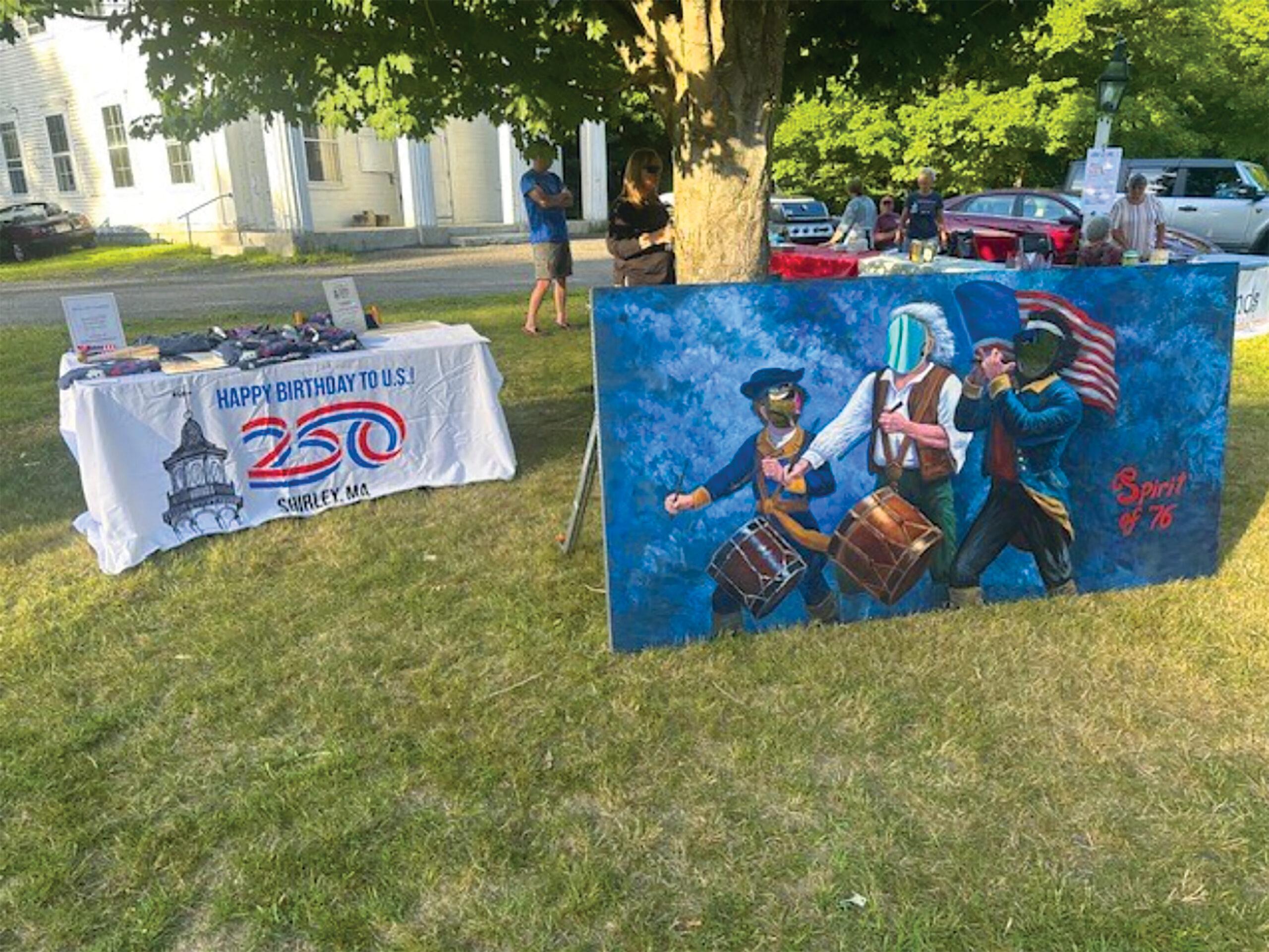
250 years ago there were about 700 people living in Shirley. At that time, most of them were farmers. Others who owned a small mill or a small store would probably also have some farmland. In March of 1776, the Massachusetts legislature asked all towns in the colony to officially debate and record their thoughts on the matter of independence. The citizens of Shirley would have gathered in the building we now call the Historic Meeting House in Shirley Center. That is where they met on Sundays for worship services and on other days to discuss town business. (Actually, only the white, property-owning men would be allowed to vote at town meetings.) On June 27, 1776, a meeting was called in Shirley. Exactly 250 years later, on Saturday evening June 27, 2026, Shirley townspeople gathered in those very same pews, in a reenactment of that meeting, to debate whether “It sometimes becomes necessary for one people to dissolve the political bands which have connected them with another.” Every Massachusetts town was requested by the Provincial Congress to “Vote on the momentous subject of Independence, asking if they will support with their lives and fortunes the actions of the honorable Continental Congress.” The question was – “Should said Congress, for the safety of the Colonies, declare themselves independent of the Kingdom of Great Britain?” As part of the 2026 evening’s program, some participants argued for independence, being angered by the taxes, rules, and restrictions laid on them by parliament, with no consideration for the needs and wants of the colonists. Other participants explained their opposite views. Families that still had property and relatives in England and were loyal to the monarchy did not want to lose that connection. Shopkeepers and other small business people got much of their merchandise and many of their raw materials from Great Britain. Their finances would suffer greatly if the country were left on its own. Unlike America, Britain had abolished slavery and Africans were welcome to join their army. Other Loyalists believed that any war with Britain would be lost before it even started. As a result, some New Englanders moved to Canada or back to Britain and some even joined the British army. However, in Shirley, the final vote was in the affirmative. Their response was sent to Boston along with 59 other towns. Then, the Massachusetts intentions were sent to their representatives in Philadelphia and on July 4, 1776 the vote was finalized. “We, therefore, the Representatives of the United States of America, in General Congress, Assembled, appealing to the Supreme Judge of the world for the rectitude of our intentions, do, in the Name, and by Authority of the good People of these Colonies, solemnly publish and declare, That these United Colonies are, and of Right ought to be Free and Independent States; that they are Absolved from all Allegiance to the British Crown, and that all political connection between them and the State of Great Britain, is and ought to be totally dissolved; and that as Free and Independent States, they have full Power to levy War, conclude Peace, contract Alliances, establish Commerce, and to do all other Acts and Things which Independent States may of right do. And for the support of this Declaration, with a firm reliance on the protection of divine Providence, we mutually pledge to each other our Lives, our Fortunes and our sacred Honor.” In Shirley in June of 2026, Tim Recko read the Declaration in full which many audience members heard for the very first time. 250 years ago, it took several days to get a copy of the signed Declaration to the state capitals. The Massachusetts copy arrived on July 15th, 1776 and Shirley received their copy on July 18th. Those present at the June 17, 2026 program were given the chance to add their names below the famous document. Folks who attend the Shirley Concerts on the Common will be able to come to the 250th table and add their names.

Ayer Shirley Youth Soccer Registration

By Melissa Schrock Registration will open June 19 for boys and girls in grades 3–8. Registration will close Aug. 19. Players are placed on skill-level-appropriate teams. The season will run from Sept. 12 to Nov. 8. Practices are scheduled on two weeknights, with games held Saturdays at the Wilde Road fields in Shirley from 9 a.m. to 6 p.m. If new uniforms are needed, the cost is $40. Players must bring their own cleats and shin guards. For more information or to register, visit the Shirley Recreation Commission website at Shirley Recreation Commission.

Village Roadway Improvement Project: Now’s Your Chance to Have a Say in Shirley’s Future!

By Janet Tice Do you sometimes feel you don’t have a say in the changes taking place around you? The Shirley Village roadway improvement project – which seeks to improve safety for pedestrians and other “vulnerable road users” in Shirley’s busy downtown – hopes to change that. Still in its earliest stages, the project team is actively seeking input from residents. As a first step, Project Manager Chris Lyman met with the Shirley Transportation Action Committee and a handful of interested residents on May 18 to provide a project overview and solicit early input. STAC was a good place to start as the committee was instrumental in obtaining the $306K planning and design grant underwriting the project. Lyman represents Howard Stein Hudson, the engineering firm hired by the Town to manage the project. Not only does HSH have local roots, the firm – and Lyman himself – has worked with the Town on several prior projects in an especially smooth and effective manner according to Town Administrator Bryan Sawyer. His knowledge of – and, yes, appreciation for – Shirley Village was on full display during the presentation in which he stressed the “hidden potential” in the Village, an area ripe for improvements that would create safe, walkable connections between residential areas and schools, shops, restaurants and commuter rail. The project timeline extends until July 2027. Data collection is already underway and will wrap up by mid-summer 2026. The conceptual design phase, which continues through January 2027, will identify specific improvements for future implementation. As the final step, one or two of these will proceed to the “preliminary design” stage sufficient to support bid requests.  Final implementation (i.e. construction) is beyond the scope of the planning and design grant and will require the Town to obtain separate grant or other funding. During his presentation, Lyman expressed genuine enthusiasm for a robust process of community outreach. With the project just getting off the ground, the STAC meeting was the first step in what will be a multi-faceted effort to engage residents in the planning process. Next steps will include attending the June 26th Concert on the Common in Shirley Center and surveying residents via questionnaire. In-person “pop-up” outreach is also planned for the commuter rail station and the elementary and middle schools during student pick-up and drop-off. These early efforts will help Lyman focus the project on the roadway areas of greatest concern to residents. Later, as recommendations begin to take shape, public presentations with lots of time for community feedback will help refine the final product: a prioritized set of improvements for future implementation. In closing, a word about STAC. Created in 2022 by a group of Shirley residents seeking to improve traffic safety, STAC was given official status as a subcommittee of the Select Board a year later and has continued to work hand- in-hand with Town leadership to implement roadway safety improvements. Since its inception, the committee has completed a number of initiatives including reducing the speed limit to 25mph in thickly-settled areas, creating the four-way stop at the intersection of Groton and Townsend Roads, adding a 20mph “safety zone” in Shirley Center, and has succeeded in securing $500K in grant funding for various transportation projects in Shirley. Be sure to play your part in shaping Shirley’s future by completing the roadway safety survey as soon as it becomes available. Can’t wait until then? Provide immediate input to contact Project Manager Chris Lyman at clyman@hshassoc.com.

Farandnear: A Shirley Treasure for All to Enjoy

By Paul Przybyla Farandnear, the beloved 87-acre nature preserve on Center Road in the middle of Shirley, bears an unusual but charming name.  The common explanation is that being 50 miles from the original owner’s family home in Wollaston, it was “far” enough away to require a two day’s journey by horse yet “near” enough to be a seasonal home. It is also possible that it may have been inspired by a famous New York lawn tennis club with a similar name. Charles Goodspeed was a Boston dealer in antiquarian books and an enthusiastic player of lawn tennis who wanted a summer place in the country, In 1902 he purchased his first three acres on Center Road, named it Farandnear, and built his summer cottage. It later became his primary residence and afterwards the home of his daughter Miriam and son-in-law Gordon Banks and finally his grandson Arthur Banks. Over the years the family added the cranberry bogs and the Paradise hemlock ravine to their property. The fence posts of the old tennis court are still visible, now surrounded by beautiful perennial gardens. Today the estate is a Trustees of Reservations property with the original residence replaced by a covered multi-use pavilion. Shirley natives best remember Farandnear for the golf course that Gordon Banks created and generously invited the public to use. Many a Shirley teenager learned to play golf there in return for helping maintain the greens.  Arthur Banks was not a golfer and replaced the golf greens with evergreen plantings to create his extensive conifer collection. Although golf eclipsed lawn tennis as the years went by, the name Farandnear may claim tennis as its provenance.  Among the antiquarian books that Arthur Banks bequeathed to Hazen Library was his grandfather’s 1886 edition of Rules of the U.S. National Lawn Tennis Association.  Listed  in that edition was the association’s president Thomas K. Fraser, of the Far and Near Lawn Tennis Club, Hastings-on Hudson, NY. One can only guess whether Charles Goodspeed fondly remembered that club name when he came to have a lawn tennis court of his own in Shirley. Today visitors can enjoy Farandnear from sunrise to sunset at no charge. Ample parking and seasonal bathrooms are provided. Dogs are welcome but must be kept on leash at all times. The formal landscaped area with its perennial gardens and conifer collection provides a perfect opportunity for a leisurely stroll or picnic on the manicured lawn, while the extensive trail system provides access to natural surroundings and a variety of different habitat types. If you’re a Shirley resident (or not!) be sure to spend an afternoon exploring this local treasure while reliving a small part of Shirley’s history. Paul Przybyla moved to Shirley in 1991. His love for local history is satisfied through volunteer work for the Shirley Historical Society and Shirley Meeting House and maintaining his 1761 colonial. Paul is also an Associate Trustee of the Trustees of Reservations. 

Groton Votes “No” on the Repair of the Squannacook Dam

By Sherry Anders At the Groton Town Meeting on May 2nd, an article to appropriate $752,500 to fund the repair of the Squannacook River Dam was placed before voters. The article required a two-thirds majority vote to pass. It failed with 125 votes in the affirmative and 182 in the negative. Included in the article was language that would have allowed special legislation to be filed to pursue a taking of the Shirley half of the dam, which is privately owned but currently in tax title. Those in favor of the repair advocated for the preservation of the mill pond and dam as historic relics of Groton’s mill history, uniquely contributing to the character of West Groton. Concern was also expressed about what would happen to the existing ecology in the pond and oxbow. Environmental advocates echoing the consensus position of regional environmental organizations argued, however, that the ecological benefits of removing the obsolete structure outweighed these concerns. Liability considerations came to the fore when a question regarding insurance was posed to Groton Town Manager Mark Haddad, who replied: “There is no insurance. We cannot get insurance on the dam, so we assume 100% liability.” The dam is classified as “High Hazard,” indicating that failure would likely result in loss of life and serious damage to homes, buildings, or other structures – a heavy risk for a town to shoulder. Bruce Easom, who serves on both the Groton Conservation Commission and the Community Preservation Committee, called attention to another serious problem. The article called for $133,000 of the total funds requested to be appropriated from the Community Preservation Fund Historic Reserve. The requirements of the Office of Dam safety, however, would require changes to the dam that would not adhere to the Secretary of the Interior’s Standards for the Treatment of Historic Properties, putting the funding at risk. With a clear “no” on the repair, what comes next? The Town of Groton has sent a letter expressing a commitment to remove the dam to the State’s Department of Ecological Restoration (DER). This expression of commitment is required for DER’s assistance in seeking the permitting and funding to catalyze removal, a process that is likely to take 2-3 years before the removal can actually begin.