Shirley Local

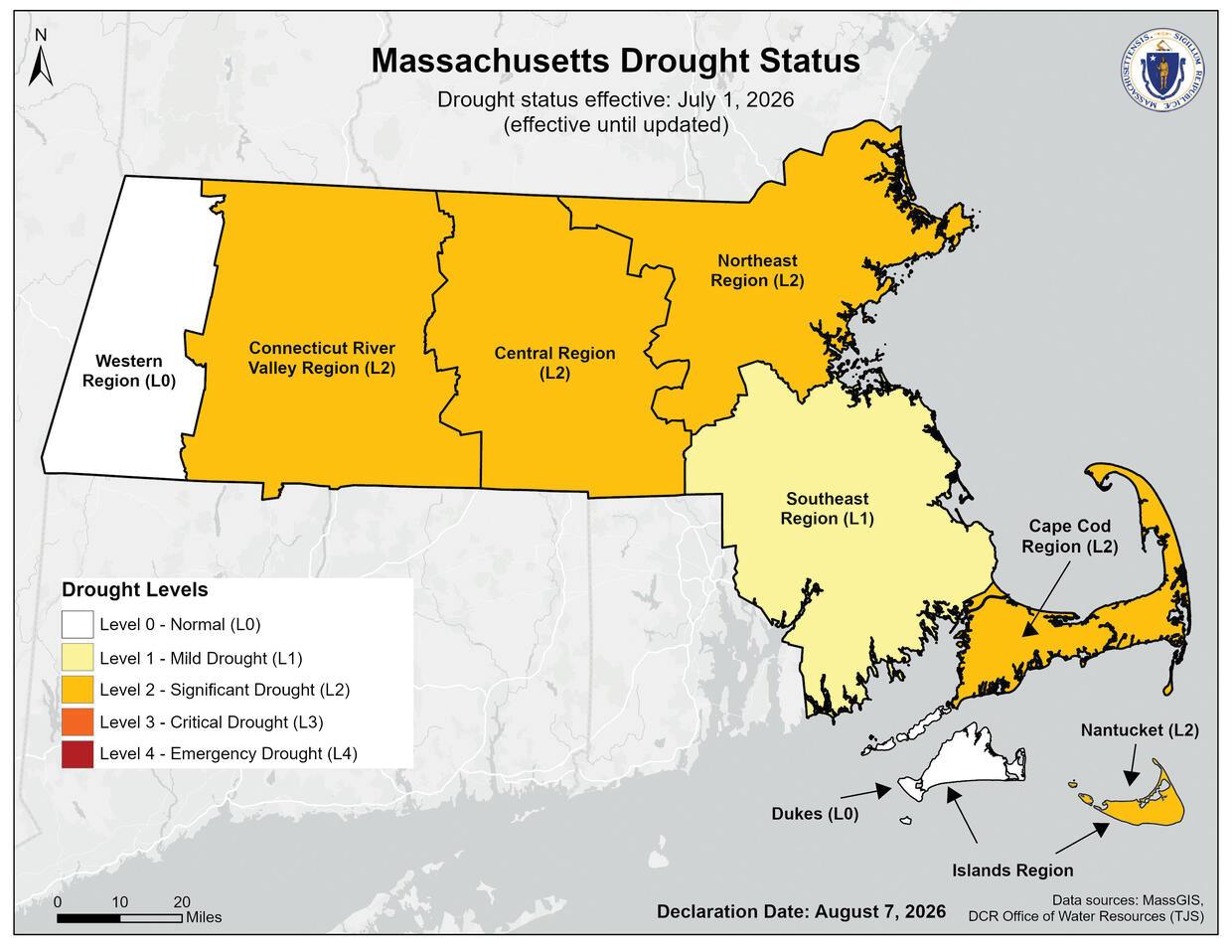
Shirley’s Drought Status Reduced to Level 2

By The Executive Office of Energy and Environmental Affairs On August 7th, Energy and Environmental Affairs (EEA) Secretary Rebecca Tepper declared the Western Region and Dukes County have returned to normal conditions after above-average rainfall in July improved drought conditions across much of Massachusetts. The following regions remain in drought: Level 2 – Significant Drought: Cape Cod, Central, Connecticut River Valley, and Northeast, as well as Nantucket County Level 1 – Mild Drought: Southeast Massachusetts received between 4.5 and nearly 9.5 inches of rain during July, with most of the state receiving more rain than is typical for the month. The rainfall helped replenish rivers, streams, and soil. Even with that improvement, drought conditions remain in parts of the state because groundwater, which supplies wells, rivers, and wetlands, recovers more slowly than rainfall. The greatest long-term precipitation deficits remain in eastern Massachusetts, particularly Nantucket, where groundwater levels continue to be well below normal despite recent rain. The Drought Management Task Force (DMTF) will continue monitoring conditions over the coming weeks to determine whether the recent rain will lead to lasting improvements. As outlined in the Massachusetts Drought Management Plan, communities in Level 2 – Significant Drought and Level 1 – Mild Drought should continue taking steps to conserve water. Although the Massachusetts Water Resources Authority’s (MWRA) water supply system is not currently experiencing drought conditions, it’s still important for residents and businesses served by the MWRA to conserve water. State agencies continue coordinating drought response efforts with federal and local partners, including municipal officials and local Boards of Health (BOH). Massachusetts Department of Environmental Protection (MassDEP) is providing technical assistance and outreach to communities affected by drought conditions. Residents are encouraged to report dry environmental conditions and upload photos through the Massachusetts Water Impact Reporter to help the state monitor drought impacts in real time. Private well owners experiencing problems such as dry wells should contact their local BOH, which is also asked to report local well conditions to the state and private well owners can learn more for information on how the drought may impact them. Additional information, including drought  FAQs, water conservation guidance, and resources for private well owners, is available online. The DMTF will meet again on August 20th at 10:00 a.m. For further information on water conservation and what residents can do, visit the EEA’s drought and water conservation pages. Below are actions communities and individuals living and working within Level 2 – Significant Drought and Level 1 – Mild Drought Regions can take, including those utilizing a private well. Residents and businesses are strongly encouraged to check with their local water system for any additional restrictions, as some communities may face more severe local water supply conditions. For Regions in Level 2 – Significant Drought Residents and Businesses: Minimize overall water use; Follow local water use restrictions; Fix indoor leaks, such as from toilets, faucets, and showers, which result in more than 60 percent of indoor use; and, For larger buildings and businesses, conduct water audits to identify areas of leaks and potential water conservation opportunities.

What Are the Dog Days of Summer?

By Meredith Marcinkewicz According to The Old Farmer’s Almanac, the Dog Days span July 3 to August 11—40 days following the summer solstice. These are traditionally the hottest and most humid weeks of the year. This year certainly felt extra hot and humid, but we survived. Dog Days relate to Sirius, the dog star. It appears in the dawn sky until mid-August, depending on your location. Sirius is the brightest star in the night sky (excluding the Sun) and can even be seen under the right conditions during daylight. As part of Canis Major—the “Greater Dog”—it earned the nickname Dog Star. Its brightness made it easy for ancient civilizations to track and attach meaning to it, from agricultural calendars in Egypt to weather superstitions in Greece and Rome. According to the Baseball Almanac – In baseball, the “dog days” refer to the grueling, slow-moving stretch of the season in late July and August. This period is characterized by exhausting hot weather, tired players, and a lull in the 162-game schedule where non-contending teams are out of the race and games can feel meaningless. For Red Sox fans, it is a time of  both discouragement and of hope.

Dog Days of Summer

By Meredith Marcinkewicz Everyone loves their dogs, but they don’t always know where to go for help giving their dog what they need. Where are local dog groomers? Where can you leave your dog overnight? What if you just need someone to walk your dog during the day? In the Shirley Local Issue #14, coming out August 21st we will be listing local dog care resources. We will not be endorsing any of them, just giving you their contact information. If YOU are a dog care provider, send your name, phone, and services to Meredith at events.shirleylocal@gmail.com. There will be a simple list of names, numbers, and services. If you want to buy an ad and include more information about your business, email TheShirleyLocal@gmail.com. If you are a dog owner and want to send a photo of your dog to be part of the story, Send the photo and $10 to TheShirleyLocal@gmail.com. NOTE: We need all this information and the ads and photos by August 12th . 

Devens Celebrates 30 Years

By Michael Sweeney, MassDevelopment’s Executive Vice President of Devens Operations Thirty years ago, the closure of Fort Devens left behind thousands of lost jobs and an uncertain future for 4,400 acres of former military land. What followed is one of Massachusetts’ most ambitious redevelopment efforts—a vision to create a sustainable, mixed-use community where businesses, residents, and innovation thrive. With financial support from the state, MassDevelopment purchased the property and undertook efforts to transform Fort Devens into what it is today—a home to leading employers, vibrant neighborhoods, protected open spaces, and a growing community.    Every day, a company in Devens breaks new ground on a product or idea that stands to change the world. Now an economic engine for Massachusetts, Devens has nearly 100 businesses with more than 7,600 high-skilled workers, including industry leaders in biopharma, clean tech, and advanced manufacturing. Devens also features a growing residential community. With restored WWII-era brick colonials and modern net-zero-energy and ultra-efficient homes, Devens offers a range of unique housing options—all nestled within open green spaces that promote community connection and year-round outdoor recreation. The legislature’s recent elimination of the 282-unit housing cap unlocks new opportunities for thoughtful growth in the years ahead. Three decades in, Devens’ success is the result of partnership, investment, and the people who shaped its evolution. MassDevelopment is grateful to our team members for leading this redevelopment effort, and to the residents and businesses who made Devens their home. We also acknowledge continued collaboration from community partners like our legislative delegation, the Devens Enterprise Commission, the Towns of Ayer, Harvard, and Shirley, and our neighbors at the Devens Reserve Forces Training Area, who carry on the region’s legacy of service. To mark this anniversary, MassDevelopment is highlighting 30 stories that capture the people, places, businesses, and moments defining Devens. I invite you to explore the series at www.devenscommunity.com.

The Graves of Shirley’s Minutemen

By Meredith Marcinkewicz Nineteen of Shirley’s Minutemen are buried in Shirley Center. Among them are Boltons, Hazens, Holdens, and Longleys. Some of their descendants still live in Shirley. Nineteen graves are marked by small Revolutionary War flag holders. On the 19th of April in 1775, 78 men and two drummer boys marched toward Concord and Lexington and kept marching along the Battle Road all the way to Cambridge. Some of them stayed defending the heights for a few days or a week or enlisted in the new revolutionary army that was forming. Others went back home to their daily life in Shirley and joined up later in the conflict. One of them was James Dickenson who was a carpenter and sawmill owner. John Dwight was a stone cutter. Moses Johnson served as the town undertaker. Joseph Brown became the church deacon. Capt. Samuel Walker was a respected agriculturalist who was later chosen to become Town Treasurer and head of the town militia. Thanks to research done by Ingrid Adam of the Shirley Cemetery Committee, a list of those nineteen men, a description of their positions in town, and a map of their gravesites are available at the Shirley Historical Society to be used for a self-guided tour. The Museum is located at #182 Center Road and is open most Mondays, Wednesdays, and Saturdays from 10:00 am – 1:00 pm. Go to mail@shirleyhistory.org for more information.

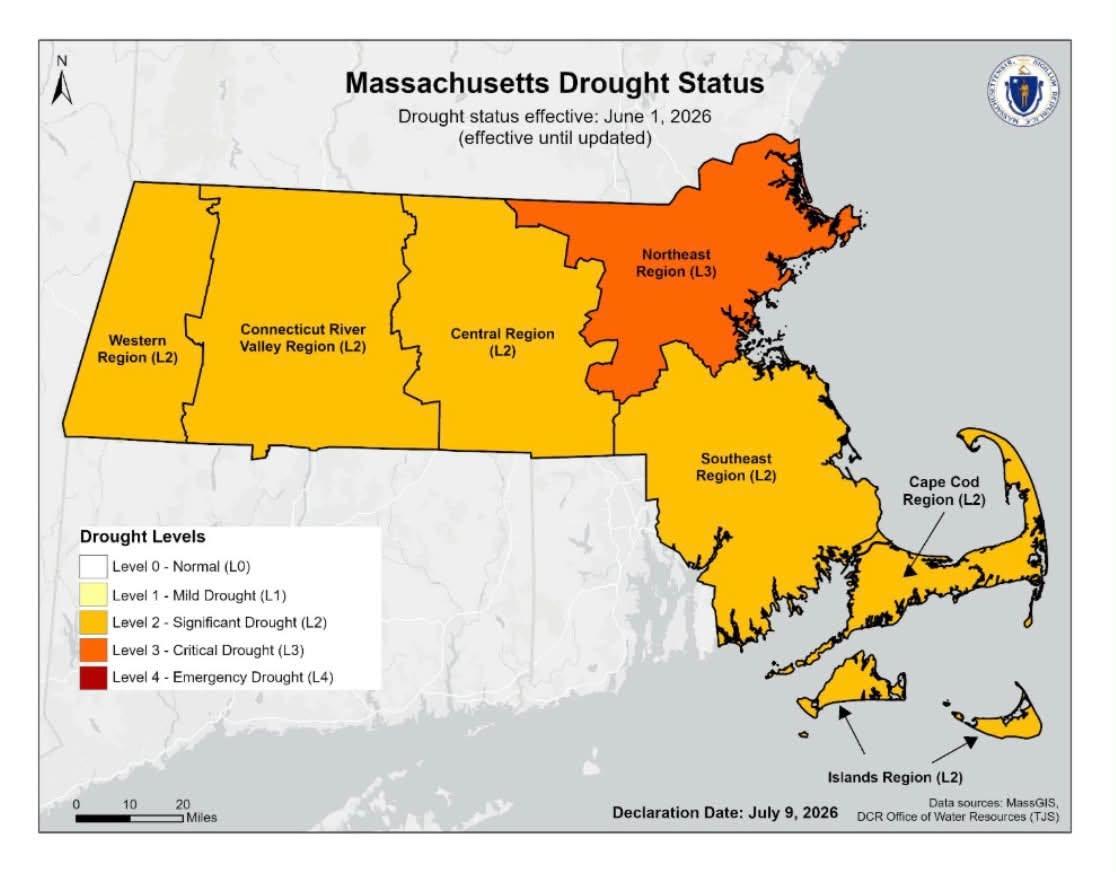
Shirley Remains in Level 3 Critical Drought

From the Executive Office of Energy and Environmental Affairs:  While much of the state received much-needed rainfall in early July resulting in temporary increases in streamflow, Massachusetts continues to experience the effects of two years of below-average precipitation. During June, the state received between 1.5 and 4.5 inches of rainfall. Precipitation deficits continue to persist in all regions, with the greatest deficits on the Islands and the eastern and far southwest parts of the state. Nantucket continues to experience severe dry conditions. Precipitation is at record low coupled with extremely high evapotranspiration, and groundwater levels have seen significant declines. The rains this week have provided some respite. Looking back over the past 3 months (May 7–July 6), most of the state has received between 50 and 100 percent of normal precipitation. The greatest deficits were observed in the eastern and far southwest part of the Commonwealth, but especially for the Islands, who have seen between 32 to 50% of normal rainfall since May 7th. Over the past 6 months (January 7–July 6), longer-term precipitation deficits continued across the Commonwealth, running about 60 to 90 percent of normal. The largest deficits continued to be confined to areas in western, eastern and northeast Massachusetts and the Islands, where precipitation ranged between 50 to 75 percent of normal. As outlined in the Massachusetts Drought Management Plan, a Level 3 – Critical Drought requires affected communities to implement a ban on nonessential outdoor water use. The drought levels also require ongoing coordination among state and federal agencies to implement drought response actions such as water-use restrictions. Additionally, engagement with municipalities, including local Boards of Health (BOH), is essential. This includes providing technical outreach and assistance to water suppliers and affected municipalities. Residents are asked to report to their local BOH if wells are drying up; BOHs are asked to report on the condition of local private wells. The Massachusetts Department of Environmental Protection (MassDEP) will continue to assist communities in managing their water systems. However, private well users and other sources of water within the same river basins are impacted by drought conditions. All sources of water, regardless of their location or type of withdrawal, ultimately draw from the same river basin. It is important for all users to do their part to conserve water. Please note that even during a drought, to continue operational activities such as flushing and spring maintenance, water suppliers may need to use higher volumes of water.    Residents can report dry environmental conditions and submit photos to help monitor the situation on the Massachusetts Water Impact Reporter. Additionally, a FAQ is now available for questions regarding the current drought status and water conservation; and private well owners can learn more for information on how the drought may impact them.    State agencies will continue to closely monitor and assess conditions across the state, coordinate any needed dissemination of information to the public, and help federal, state, and local agencies prepare additional responses that may be needed in the future. The DMTF will meet again on August 6th at 10:00 AM. For further information on water conservation and what residents can do, visit the EEA’s drought and water conservation pages.

Shirley’s Memorial Caisson

By Sharon Landry The crosses on the Memorial Caisson represent Shirley residents who were killed in action in WWI, WWII, the Korean and Vietnam wars. At first, the crosses were stuck in the ground where the monuments are in Whitely Park by the DAV.  When the WWI monument was moved from the diamond on Harvard & Lancaster Road to Whitely Park they couldn’t go there anymore so the Legion built the platform to mount the crosses.    According to the Cambridge Dictionary,  this kind of caisson is a two-wheeled wagon or chest used to transport artillery ammunition near the battlefield. In modern times, these retired military wagons are most commonly seen in military funerals (such as those at Arlington National Cemetery) to carry a casket, followed by a riderless horse.  Rudy Kurtyka originally donated the Shirley Caisson, which came from the National Guard back in the 50s or 60s.  Originally it was an ammunition carrier, the original doors and tubes are still there but you can’t see them because of the platform.    Joe Landry painted it black and built the dolly under the caisson to be able to move it around for Wilma Brown’s funeral in Harvard.  Crosses were mounted after that.    Joe remembers the caisson being used for Alfred “Beechie” Beach’s funeral and he thinks it was also used for Rudy Kurtyka’s funeral.  Possibly others that he doesn’t remember. About 20+ years ago John Guthrie and Joe put the current platform on with the green rug, which was donated by the McNiff family. Joe instigated the recent refurbishment because when he visited other military cemeteries, he was ashamed of how ours looked.  He originally offered to pay to have it done but the Legion paid for part and part was donated and done by a company with an office at Phoenix Park which Gerry Wheeler arranged.  Gerry is also the one who usually moves it around and keeps it updated. Visitors to Whitely Park can walk around all four sides of the caisson to see all the names of these young Shirley men who sacrificed themselves for their country.

Shirley Resident Douglas Landry Confirmed as Littleton’s Next Chief of Police

By Katie Aponte The Littleton Select Board officially confirmed Lieutenant Douglas W. Landry as the town’s next Chief of Police.  A lifelong resident of Shirley, Douglas steps into the role after completing a rigorous selection process that included a comprehensive outside agency assessment center and interviews with Select Board members. During a special Select Board meeting which took place on June 30th, Landry received a unanimous vote from the board and addressed questions, outlining his vision for leading the Littleton Police Department—one centered on transparency, community partnership, and servant leadership. Landry’s connection to law enforcement began early. A graduate of Ayer High School, he participated in a daily internship with the Shirley Police Department during his senior year under then-Chief Paul Thibodeau—an experience that helped set him on his career path. He later worked a short stint as a part-time communications dispatcher for Shirley Police before going on to become a sworn police officer. Landry went on to spend four years as a police officer for the Nantucket Police Department, before transferring to the Littleton Police Department, where his career reflects dedicated service, progressing from patrol officer to Sergeant to Lieutenant, and now Chief of Police. Chief Landry brings a strong academic foundation to the position. Along with years of professional development in police supervision and executive leadership, he holds a Master’s degree in Public Administration from Anna Maria College and Bachelor’s degrees in Criminal Justice and Psychology from Westfield State University. In 2023, he completed the prestigious University of Louisville Southern Police Institute Command Officer’s Development Course. This fall he will attend Suffolk University’s Local Government Leadership and Management certificate program. Beyond his departmental roles, Chief Landry has spent more than a decade as a Municipal Police Training Council instructor, shaping countless academy recruits who have gone on to serve as officers across the region. He also dedicated ten years to the NEMLEC Regional Response Team, including seven years on the unit’s SWAT team, responding to critical incidents throughout the northeast. At the conclusion of the meeting, Landry thanked his family and colleagues for their support and expressed his excitement for the department’s future. He emphasized his commitment to leading with integrity and building a modern, community-focused police force. Congratulations to Chief Landry on this well-earned achievement. 

Escape to Arabian Tales with Disney’s Aladdin JR.

What does it take to bring the story of Aladdin JR. to life with music, dance and adventure? ShirleyArts! is doing just that with a cast of 36 students ages 8-18, a staff of six, three weeks of rehearsals and the efforts of more than a dozen volunteers working on scenery, costumes and props. Featuring beloved songs including “A Whole New World” and “Friend Like Me,” with music by Alan Menken and lyrics by Howard Ashman, Tim Rice and Chad Beguelin, the production promises an entertaining experience for audiences of all ages. The ShirleyArts! production stars Jack Keaveny as Aladdin and Kiana Starr as Jasmine. John Marble plays the Genie, while Zain Kahn takes on the role of Jafar. Supporting cast members include Shayla Payatt as Iago and Drew Harland as the Sultan, along with 32 additional students performing multiple roles throughout the show. Meredith Marcinkewicz serves as director and producer, with Laurie Marcinkewicz as choreographer. Performances will be held at the Ayer-Shirley Middle School Auditorium on: Friday, July 17, at 7 p.m. Saturday, July 18, at 7 p.m. Sunday, July 19, at 2 p.m. General seating tickets will be available at the door for all performances. Advance tickets may be purchased at www.shirleyarts.info. Based on the Disney film written by Ron Clements, John Musker, Ted Elliott and Terry Rossio, and directed and produced by Clements and Musker, Disney’s Aladdin JR. is presented through special arrangement with Music Theatre International.

Protecting Shirley’s Street Trees and Stone Walls – Your Voice Matters

By: Janet Tice The trees and stone walls lining Shirley’s roadways are valuable assets that contribute to the scenic, rural character prized by community residents. Since they are located in the public right-of-way, which typically extends 10-15 feet beyond the pavement, these trees and stone walls belong to the Town of Shirley, not to abutters. Decisions regarding their care, maintenance, removal and replacement are thus a public matter and, as such, are often codified in a town’s bylaws. But, at least currently, not in Shirley’s. That, in a nutshell, is why the Planning Board is proposing two new bylaws that would provide protection for trees and stone walls within the public right-of-way on all town roads in Shirley. The proposed bylaws need approval by voters and were placed on the warrant for Annual Town Meeting this past May. Last minute questions and concerns from Conservation Agent Mike Fleming regarding the bylaws’ impact, if any, on conservation properties persuaded the Planning Board to withdraw the articles to allow for further discussion. This also gives Shirley residents another chance to participate and provide input. Although public hearings on the bylaws were held by the Planning Board in the run-up to the ATM, they are now on the agenda for discussion by the Conservation Commission and the Planning Board on July 14th and 15th, respectively, thus giving residents another opportunity to weigh in. Any agreed-upon changes or clarifications will be incorporated into revised versions of the bylaws, with consideration by voters scheduled for Special Town Meeting in November. The proposed bylaws establish a formal approval process that would be required before any trees or stone walls within or bounding the right-of-way can be removed or disturbed. If approval is granted, the bylaw requires tree and/or stone wall replacement or equivalent reimbursement to the town. Conversely, removal, destruction or disturbance of town trees or stonewalls without prior approval according to the new process would result in a fine payable to the town to be used solely for tree planting and/or maintenance of trees and stone walls. In sum, the bylaws: protect and preserve scenic and historic features of Shirley roadways. require prior approval for removal or disturbance of trees or stone walls in the right-of-way. exempt hazardous trees and roadside maintenance. The formal approval process called for in the bylaws includes a public hearing before the tree warden and/or Planning Board, allowing for input from residents, abutters and town boards and commissions. If approval is granted, the bylaw requires that the applicant replace any trees or stone walls removed or pay an equivalent sum to the town to be used solely for tree planting and maintenance of trees and stone walls. By creating procedures for implementation at the local level, the bylaws are designed to function in harmony with state laws that provide some limited protection for public shade trees and “designated” scenic roads (MGL Chapter 87, Section 3 and Chapter 40, Section 15C, respectively). They also align Shirley with the many cities and towns in Massachusetts that already have similar bylaws on the books. So plan to attend the Conservation Commission meeting on Tuesday, July 14 or the Planning Board meeting on Wednesday, July 15 and provide your input. Your voice matters!   Janet Tice is a 40-year resident of Shirley. Although she is a current member of the Shirley Planning Board, this article is her own personal contribution and is not meant to represent the Planning Board.