
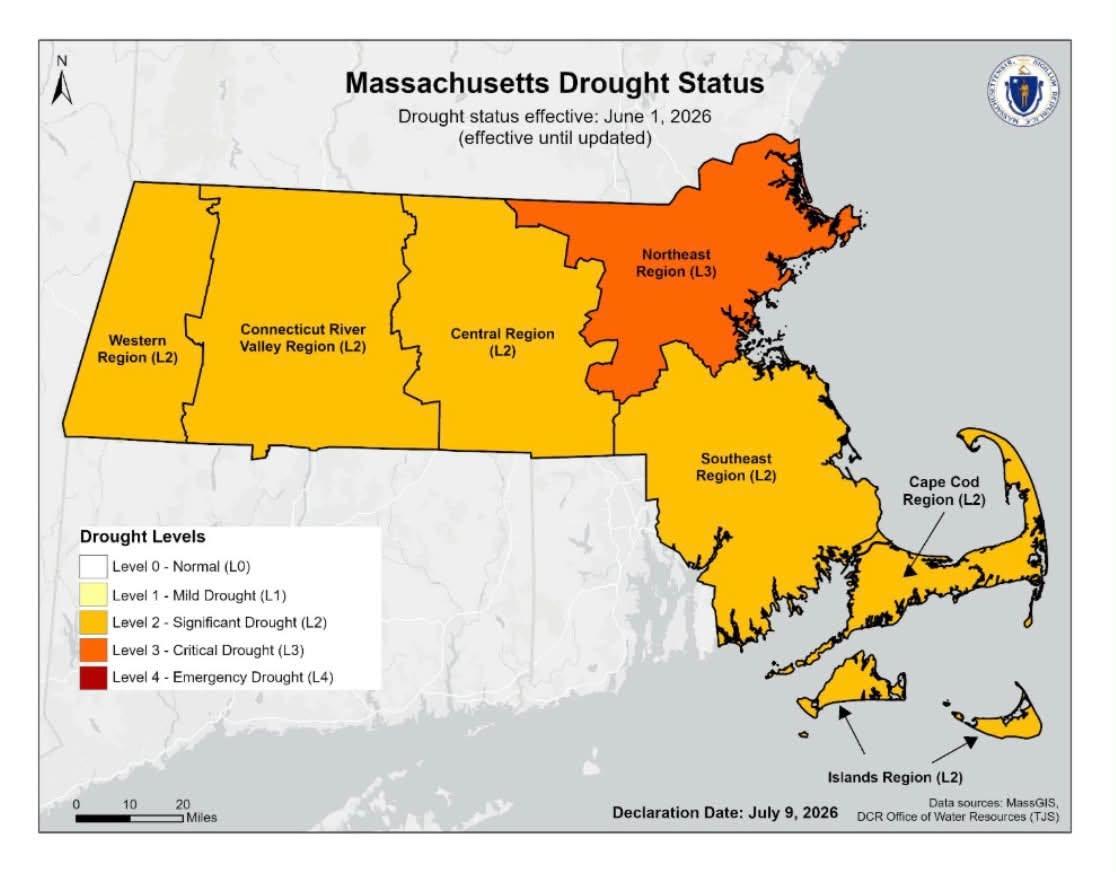
Shirley Remains in Level 3 Critical Drought
From the Executive Office of Energy and Environmental Affairs: While much of the state received much-needed rainfall in early July resulting in temporary increases in streamflow, Massachusetts continues to experience the effects of two years of below-average precipitation. During June, the state received between 1.5 and 4.5 inches of rainfall. Precipitation deficits continue to persist in all regions, with the greatest deficits on the Islands and the eastern and far southwest parts of the state. Nantucket continues to experience severe dry conditions. Precipitation is at record low coupled with extremely high evapotranspiration, and groundwater levels have seen significant declines. The rains this week have provided some respite. Looking back over the past 3 months (May 7–July 6), most of the state has received between 50 and 100 percent of normal precipitation. The greatest deficits were observed in the eastern and far southwest part of the Commonwealth, but especially for the Islands, who have seen between 32 to 50% of normal rainfall since May 7th. Over the past 6 months (January 7–July 6), longer-term precipitation deficits continued across the Commonwealth, running about 60 to 90 percent of normal. The largest deficits continued to be confined to areas in western, eastern and northeast Massachusetts and the Islands, where precipitation ranged between 50 to 75 percent of normal. As outlined in the Massachusetts Drought Management Plan, a Level 3 – Critical Drought requires affected communities to implement a ban on nonessential outdoor water use. The drought levels also require ongoing coordination among state and federal agencies to implement drought response actions such as water-use restrictions. Additionally, engagement with municipalities, including local Boards of Health (BOH), is essential. This includes providing technical outreach and assistance to water suppliers and affected municipalities. Residents are asked to report to their local BOH if wells are drying up; BOHs are asked to report on the condition of local private wells. The Massachusetts Department of Environmental Protection (MassDEP) will continue to assist communities in managing their water systems. However, private well users and other sources of water within the same river basins are impacted by drought conditions. All sources of water, regardless of their location or type of withdrawal, ultimately draw from the same river basin. It is important for all users to do their part to conserve water. Please note that even during a drought, to continue operational activities such as flushing and spring maintenance, water suppliers may need to use higher volumes of water. Residents can report dry environmental conditions and submit photos to help monitor the situation on the Massachusetts Water Impact Reporter. Additionally, a FAQ is now available for questions regarding the current drought status and water conservation; and private well owners can learn more for information on how the drought may impact them. State agencies will continue to closely monitor and assess conditions across the state, coordinate any needed dissemination of information to the public, and help federal, state, and local agencies prepare additional responses that may be needed in the future. The DMTF will meet again on August 6th at 10:00 AM. For further information on water conservation and what residents can do, visit the EEA’s drought and water conservation pages.
